
In part four of Vera’s Unlocking AI for Social Impact webinar series, we sat down with Seth Cochran, founder and CEO, and Helen Davies, COO, of Operation Fistula to talk through their recent five-week Claude for Nonprofits implementation. Pamela Mac Quilkan, senior project manager at Vera, and Joe Bird, senior business development manager at Vera, joined to share how the project came together. The conversation covered where Operation Fistula’s AI journey started, the use cases the team chose, what surprised them along the way, and their advice for other nonprofits considering Claude or AI more broadly.
Summary:
- Operation Fistula funds and coordinates fistula surgeries across 22 countries and validates every patient record before releasing payment to surgeons.
- Prior to this engagement, AI use at Operation Fistula was individual and informal, with no shared governance or data policy.
- Vera and Operation Fistula moved from discovery through design, build, and enablement, prioritizing a few key use cases and ruling out ideas such as facial recognition along the way .
- Two Claude Skills went live: a Surgical QA skill that flags data quality issues and a Surgical Data Analyst skill that answers plain-language questions about program data.
Setting the scene
Operation Fistula is on a mission to end obstetric fistula for every woman, everywhere. They do this by paying surgeons directly for validated fistula surgeries. Rather than issuing a grant and hoping for the best, the organization reviews every patient record before releasing payment, then feeds that data back to surgeons so they can see trends in their own work and, in result, improve quality. Data integrity is tied directly to patient outcomes and to how money moves through Operation Fistula’s programmatic model.
Prior to this project
Before this project, Operation Fistula used AI the way many organizations we’ve worked with do: individual staff members chose their own tools, without a shared approach or a governance framework. Seth made clear that the team would not put patient data into any AI tool without strong safeguards, because that data belongs to the patients Operation Fistula serves. Two factors gave the team the confidence to move forward. Anthropic has a public track record in safety research, and Vera works with Anthropic as a partner through Anthropic’s Beneficial Deployments program. With that assurance, Operation Fistula began exploring how AI could automate routine program tasks and improve the quality of that work.
Selecting the right use cases
Vera’s initial approach to this engagement was the same as on any other system delivery project: discovery to align on existing processes and systems, identify gaps, and gain buy-in from the relevant functional teams. Two workshops focused on two questions: (1) What is costing you the most time today? (2) What would you do with that time back? These questions surfaced around 20 potential Claude use cases for Operation Fistula. Some were viable; others needed a direct “not yet” or “not suitable for AI.”
Helen shared her appreciation for Vera’s direct recommendations, in particular its candid “no” to use cases that weren’t well suited to AI, such as a proposed facial-recognition approach to detecting duplicate patient records. The Operation Fistula team was keen to expand how they used Claude, and Vera helped focus that ambition on what would serve program participants and surgeons in the field, with responsible data practices as the first priority.
Two use cases moved forward:
1. Surgical QA skill: A skill used by project managers that batches the review of surgery records from Airtable, surfaces flagged entries by severity on a Claude dashboard, and drafts multilingual follow-up emails to surgeons based on QA flags. Clean records can be batch-approved in a single action, writing back to Airtable, while flagged ones generate a draft email in English, French, or Portuguese that sits in Gmail for human review before sending.
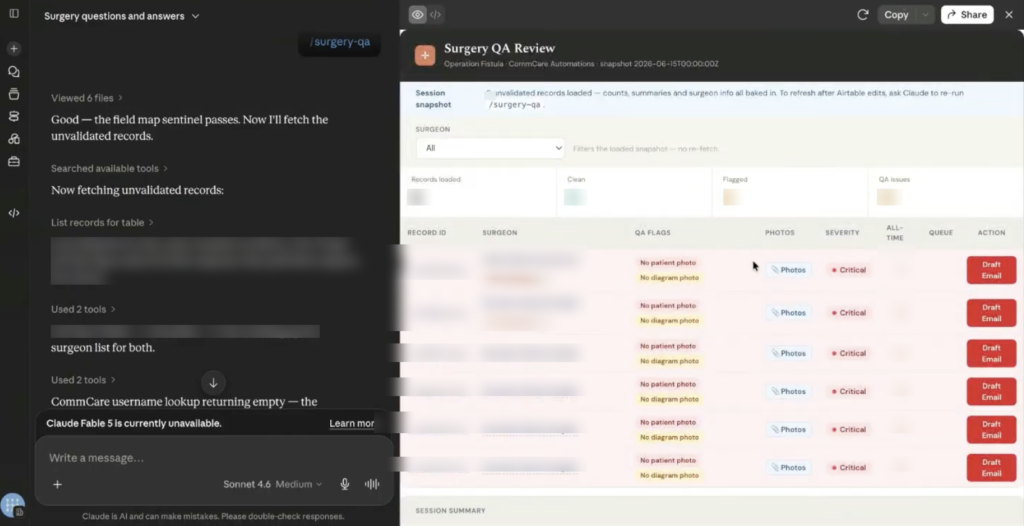
2. Surgical Data Analyst skill: A read-only, plain-language query skill that allows any team member to ask questions about program data in Airtable, such as iatrogenic fistula rates by country, without needing to understand the underlying data structure.
Claude Skill design moved through user stories and acceptance criteria and into a solution playback session, which identified a few incorrect assumptions before they escalated into data privacy issues. The build itself anchored to one principle: nothing gets sent or actioned in Claude without a person first reviewing it.
The implementation journey
Helen and Seth both pointed to enablement as the most influential element. Written guides supported their team; however, live working sessions, where staff edited a skill themselves and saw it respond to their own data in real time, most significantly shifted learning, growth, and, in response, Claude engagement. Helen described one moment clearly: testing Claude’s output against her Program Manager’s own human-validated totals for the first six months of the year, and confirming the numbers matched.
Advice for the sector
Seth’s advice to other nonprofit leaders: “find a partner who understands these tools well enough to guide you through what is possible, not just what is available.”
He pointed to a specific example: a data query that would have taken a skilled analyst around 10 days, including back-and-forth to prepare the data, took Helen about 30 minutes once the Surgical Data Analyst skill was built. In the same process, Claude surfaced a hidden detail: clusters of patients whose care had happened in a different country from where they lived, including one patient in Chad. Helen had not queried for that insight. It surfaced in the analysis.
Both leaders were clear this is not a plug-in-and-done technology. It takes dedicated time, clean and well-managed data, and a mentor who has already worked through the governance questions: Who can see what? How is access controlled? Who is responsible for the rules the AI is taught to follow? Operation Fistula is now considering an AI administrator role internally and is looking ahead to a broader data infrastructure project that would bring CommCare, Airtable, QuickBooks, and Google Drive data into one queryable layer.
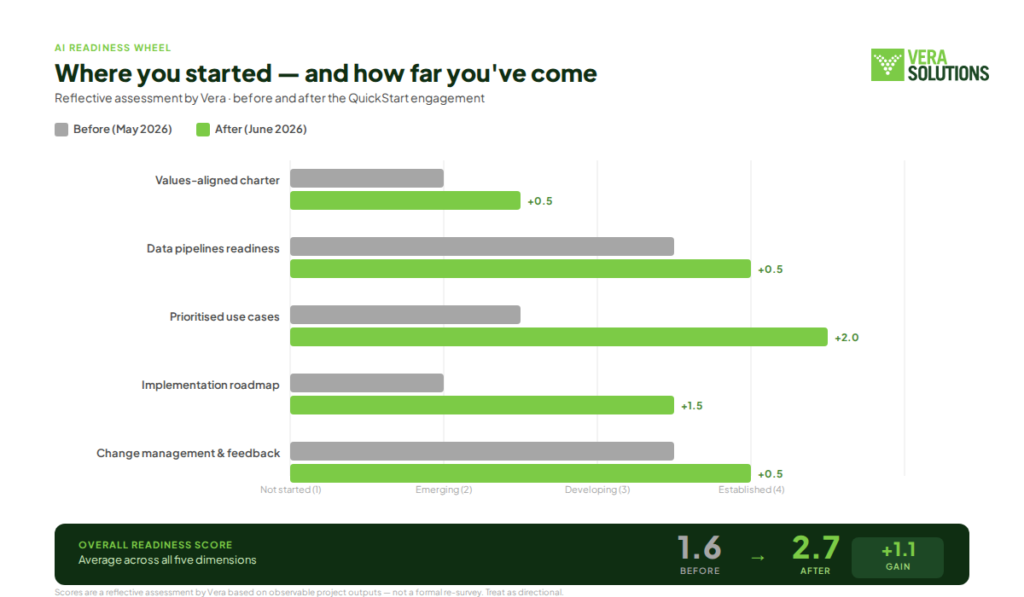
Description: Operation Fistula AI Readiness Assessment Playback
Ready to start your own AI journey?
If you are curious about what AI could do for your organization but are not sure where to begin, Vera can help identify your starting point. Start an AI Readiness Assessment to understand where you stand today. Kick off a responsible Claude for Nonprofits pilot with support from a team that has done this before. Set up an AI Strategy Consultation with Vera to talk through your specific challenges. Join our AI Peer Learning Group to connect with other social sector organizations navigating the same questions.
Which AI tool did Operation Fistula implement?
Operation Fistula implemented Enterprise licenses from Claude for Nonprofits, with support from Vera, to meet HIPAA compliance requirements for handling sensitive patient data.
What use cases did Operation Fistula build with Claude?
Operation Fistula built two skills: a Surgical QA skill that reviews surgery records for data quality issues and drafts multilingual follow-up emails to surgeons, and a Surgical Data Analyst skill that answers plain-language questions about program data.
Why did Vera recommend against a facial recognition use case?
Vera advised against a facial recognition approach to detecting duplicate patient records due to the risk of model bias against the populations Operation Fistula serves, most of whom are underrepresented in the data large language models are trained on.
How long did the Operation Fistula project take?
The engagement ran across five weeks, moving through discovery, design, build, and enablement phases.
How can other nonprofits get started with AI?
We offer a few different ways to help social impact organizations build responsible, practical AI solutions. For hands-on, structured support, Vera Solutions can help your team with:
- Advisory Services to help you make sense of your data, prepare for an AI implementation, navigate AI responsibly, and build strategies that fit your context
- Implementation Services to pilot and build technology and data solutions, including AI tools such as Claude for Nonprofits, Microsoft Copilot, and Google Gemini
- Enablement Services, including AI Enablement and AI Managed Services, to ensure you are equipped to use those systems with confidence
Have an AI project in mind? Tell us about it.