
Vera is on a mission to amplify the impact of the social sector by helping impact-driven organizations save time, money, and headaches. Beyond our products and services, we’re committed to investing in the collective capacity of the sector to navigate complex, fast-moving challenges, including AI. The AI Peer Learning Group is a space we created for this purpose; open to anyone working to advance social and environmental outcomes.
Summary:
How Is the AI Peer Learning Group Built?
Based on participant input, we set the discussion topics and moderate the sessions, while the conversation belongs to the participants. This is a peer-led space where organizations share AI use cases, challenges, and learnings. Conversations range from the strategic, such as how an organization decides which AI tools or use cases are worth pursuing, to the tactical, such as a specific use case a team has implemented and how they did it. We ask participants to share where they are in their journey, including the parts still in progress. Unfinished experiences and open questions tend to generate the most useful exchanges and that willingness to share openly is what makes the learning meaningful.
Session 1: Who Are We and Where Do We Stand?
The first session, held on 19 May 2026, was about orientation: getting to know each other, establishing shared language, and understanding where everyone sits on the AI readiness spectrum.
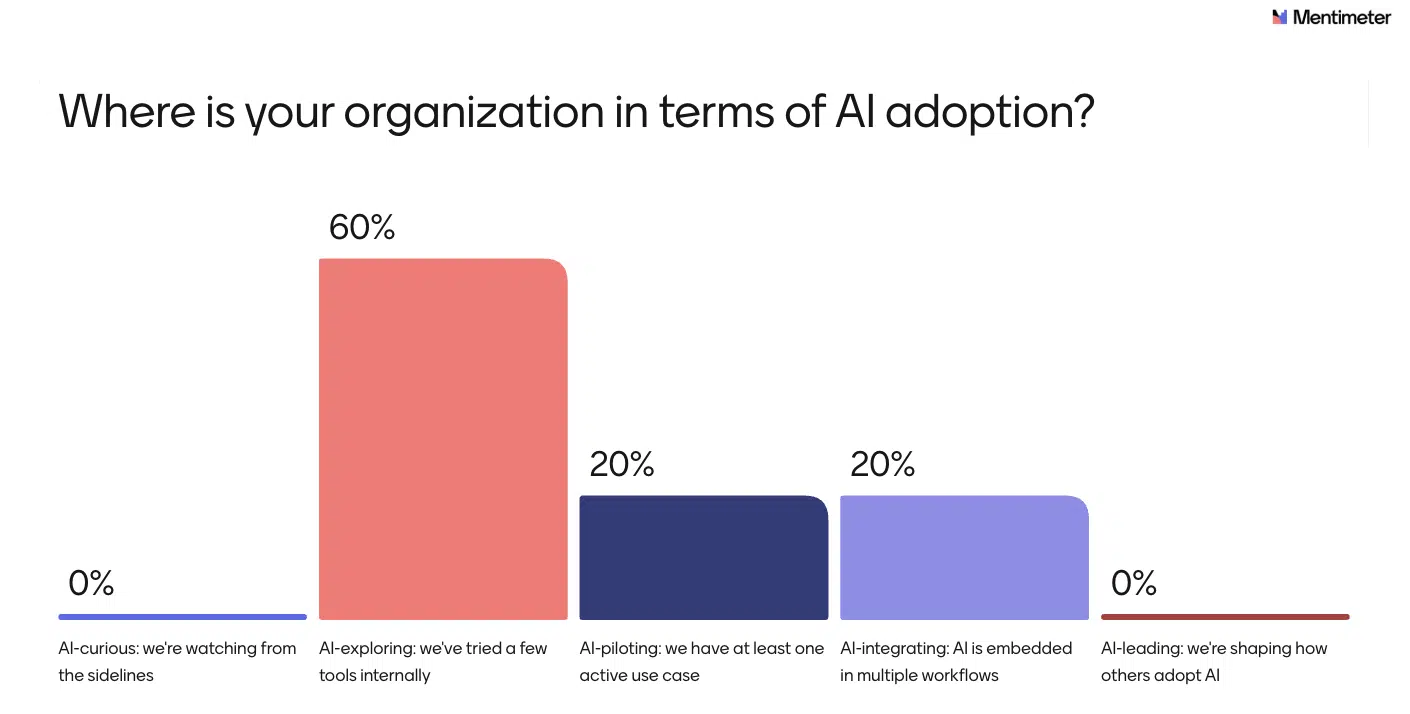
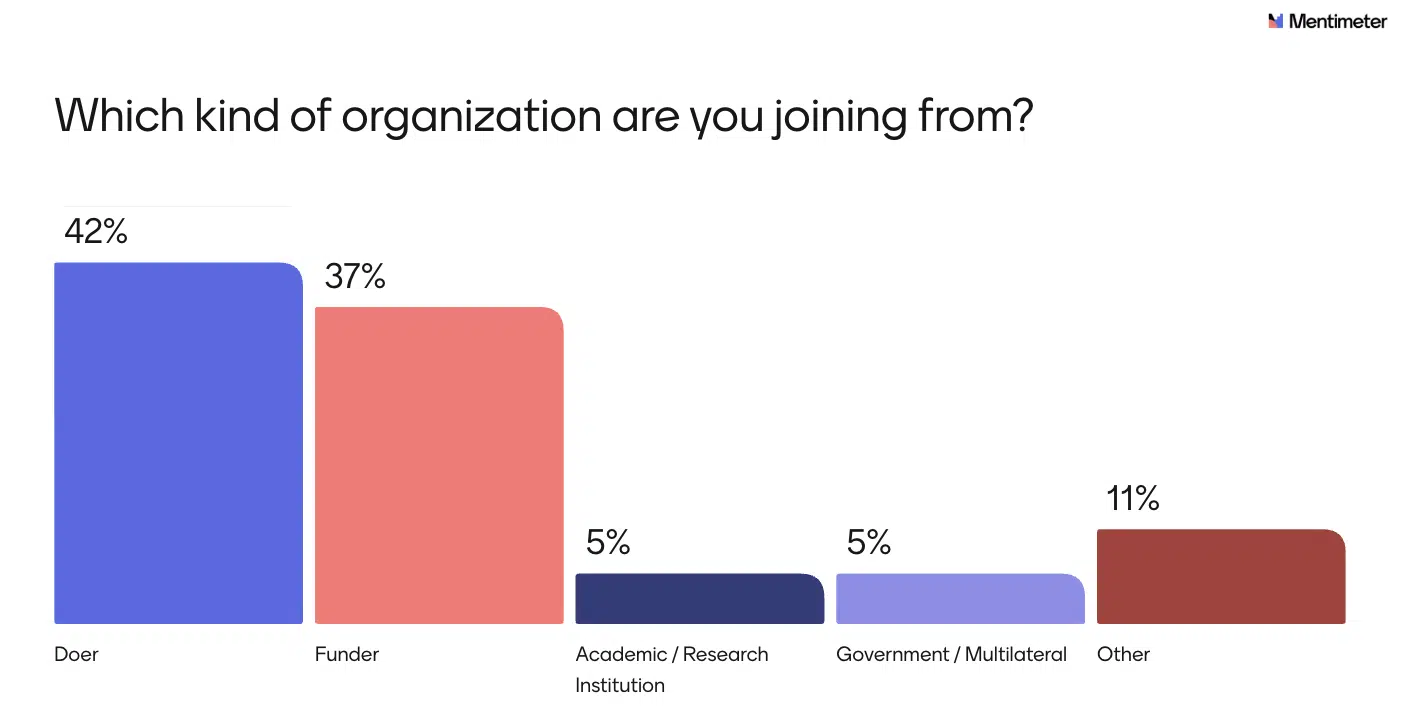
We used that session to map the landscape of the group itself. The poll results showed that: 60% of participants described themselves as AI-exploring, having tried a few tools internally, while 20% were actively piloting at least one use case and another 20% had AI embedded across multiple workflows. The group also spanned a range of organization types across the sector, with doers (42%) and funders (37%) making up the majority, alongside academic institutions, government bodies, and multilateral organizations
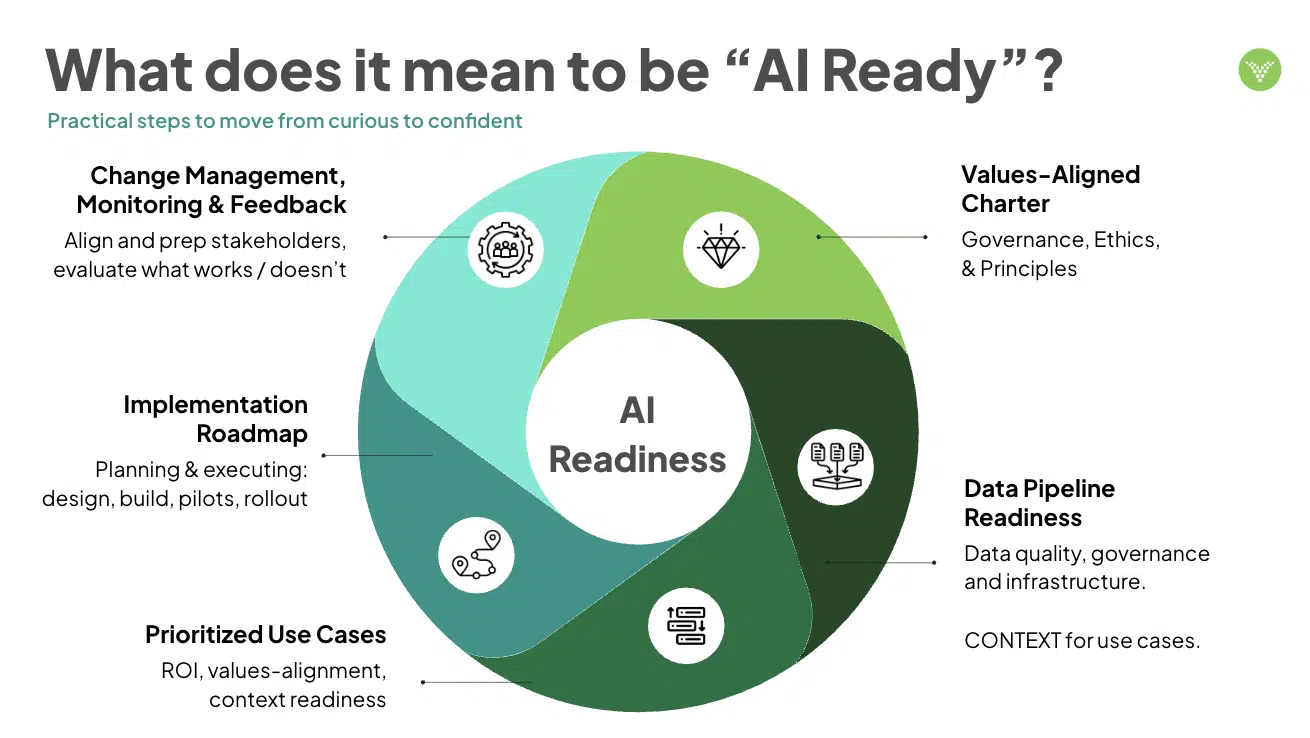
The first session also introduced Vera’s AI Readiness Framework, built around five pillars: a values-aligned charter that defines how an organization will use AI responsibly; data pipeline readiness to ensure the information feeding AI tools is clean and accessible; prioritized use cases that match AI to the tasks where it can add the most value; an implementation roadmap that connects tools to existing systems and strategy; and change management to build staff trust, literacy, and sustained adoption.
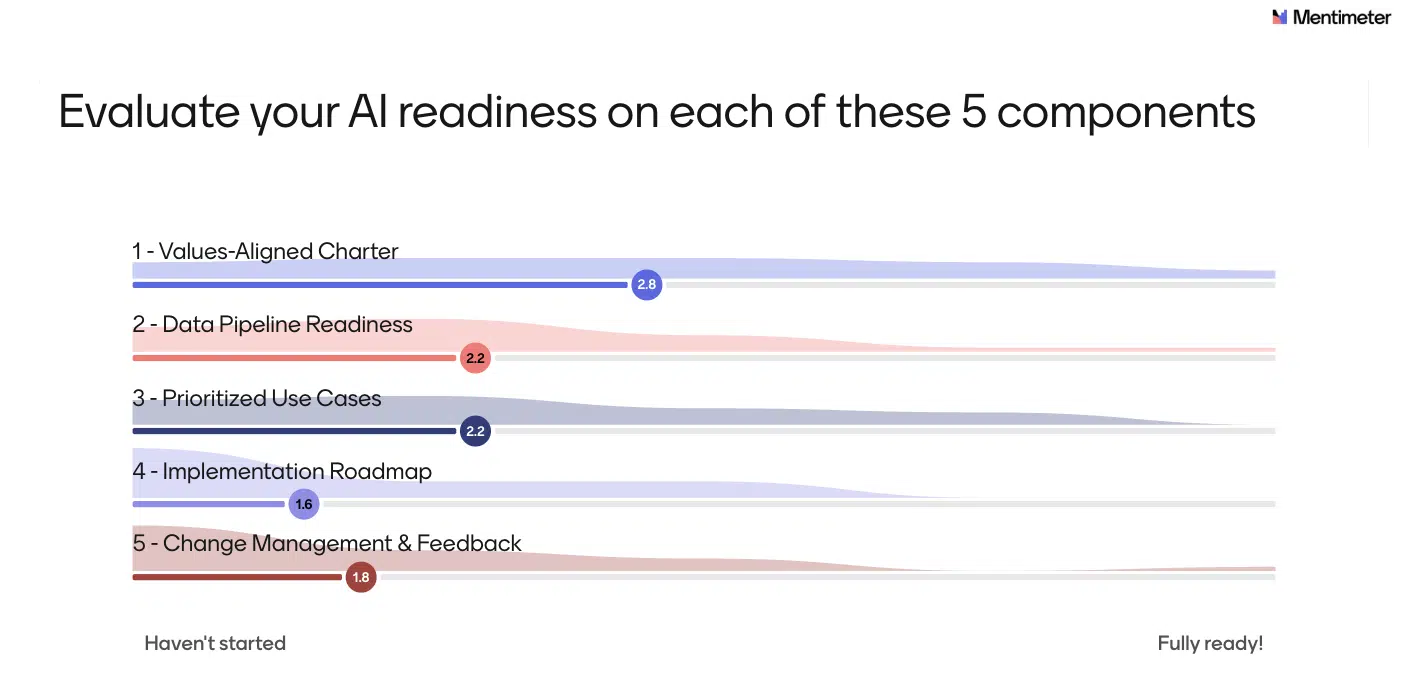
Participants were then invited to self-assess their organization’s readiness across each of the five pillars, on a scale from 0 (haven’t started) to 5 (fully ready). The results revealed that most organizations feel relatively more confident in having a Values-Aligned Charter (2.8), while Implementation Roadmap (1.6) and Change Management & Feedback (1.8) scored the lowest, signaling that translating AI intention into action remains the biggest gap for the sector.
We spent time on the governance layer in particular, as it is often where organizations start late and have to course-correct down the line. The participant responses reflected a wide spectrum. Some were just finding their footing, still having internal conversations and beginning to explore what a policy might look like: “just starting, no official group, just individuals exploring and following IT provider advice” and “we are just getting started, also hosting a workshop for program participants on this”. Others had defined their principles but were working through the harder task of formalizing them, navigating workers’ councils, training staff or simply the pace of organizational change. A smaller number had reached a more embedded stage, with formal AI committees, trained champions, and policies already being updated to account for agentic AI. The spread was itself a useful data point: governance is a challenge organizations at every stage are still actively working through.
Session 2: From Planning to Implementation
The second session, held on 9 June 2026, focused on AI implementation. The topic was voted on by participants at the end of Session 1, reflecting where most organizations in the group are: past the question of whether to use AI and to develop AI governance, and into the practicalities of execution.
We opened the session with a grounding observation from Vera’s own pilot work: AI performs best when the foundations are already in place. Clean data, documented processes, and team alignment determine the quality of the output. Without those, AI tends to amplify existing gaps rather than compensate for them.
From there, we broke into groups using a shared Lucid board, with separate zones for those who have already implemented AI and those who have not yet done so.
From those still in the planning stage
The concerns that surfaced were about Return on Investment (ROI), execution, and sustainability.
Data readiness was the other recurring thread. Participants named messy records, undocumented processes, and inconsistent data entry as the upstream problems that would undermine any AI workflow before it started. Several noted that working toward AI implementation had forced a useful reckoning with data hygiene and security issues the organization had been deferring for years.
What participants said they needed most was a practical catalog mapping tools to specific use cases, access to peers who have done something similar, and in some cases a technical advisor who understands the social sector context well enough to help design a workflow correctly.
From those still in the planning stage
The lessons that surfaced were about craft, oversight, and organizational rhythm.
On the adoption side, the approaches that worked were straightforward: start with a single task the AI handles well, invite colleagues to try it, and let peer observation do the work that formal training cannot. Monthly team check-ins to share prompting strategies and flag problems helped maintain trust over time.
Quick wins that surprised people included using Claude to set up and configure project management tools from a plain-language description, running requirements through the model to evaluate new tools, and building reusable prompt frameworks that could be applied across recurring deliverables.
Blockers and What Would Help
When we asked what’s holding organizations back from using AI more, staff capacity and time to learn came out on top by a wide margin (53%). Data privacy and security concerns came second (35%). Budget and leadership buy-in were barely mentioned.
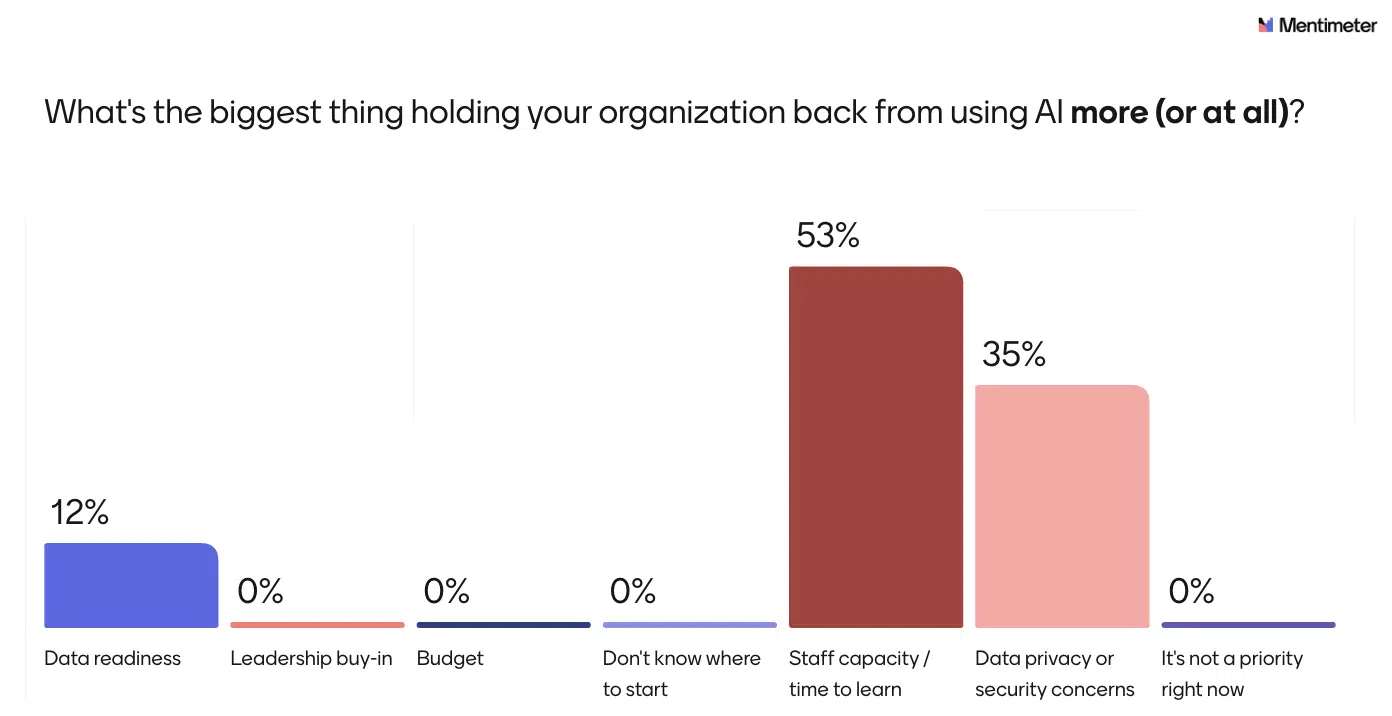
The barrier to AI adoption in the social sector is bandwidth. People are interested, leadership is on board, but few have time to figure it out properly.
When we asked participants what would help, answers were pretty specific: better data governance, more real-world use cases from organizations doing similar work, dedicated training time, clearer guidance on which tools fit which use cases, and a more honest conversation about what AI costs, both financially and environmentally.
One response that stayed with us: “The best of AI is the time it gives back to us. The best for us is what we do with it.”
What Comes Next
Our next session takes place on Tuesday 7 July 2026. We will be hearing from an organization sharing how they have integrated AI into their programs: the use cases they chose, what the implementation journey looked like, and the results they are seeing on the ground.
If you are not yet part of the group, this is a standing invitation. The AI Peer Learning Group is open to any organization doing social sector work, regardless of size, geography, or whether you have ever worked with Vera. You do not need to have an AI strategy or a use case in place to participate. The only requirement is a willingness to engage with where you are and what you are learning.