
In the third installment of our Unlocking AI for Social Impact webinar series, we went deeper into what it takes to move from AI curiosity to organizational confidence. Our first session introduced Claude for Nonprofits and the landscape of AI tools available to mission-driven organizations (catch up on the recording here). Our second explored how AI can transform financial workflows — from grant reporting to budget analysis (catch up on the recording here).
In this session, we unpacked a practical, five-pillar AI Readiness framework and walked through an example of how we’re applying it with a client. If you’ve been wondering how to move from scattered AI experiments to something more intentional and organization-wide, this is where we started to answer that question.
Summary:
- AI readiness isn’t about being the largest or best-resourced organization. It’s about starting intentionally and building momentum across five key pillars.
- The five pillars (Values-Aligned Charter, Data Pipeline Readiness, Prioritized Use Cases, Implementation Roadmap, and Change Management) give organizations a structured path from AI-curious to AI-leading.
- Good data doesn’t have to come first. A data inventory is enough to get started, while you work in parallel to improve quality for higher-stakes use cases.
- A Vera client example shows the framework in action: a global health nonprofit moving toward centralized AI use, integrated workflows, and growing staff fluency.
- AI fluency works like fitness. You never “complete” it. The organizations that lead on AI are the ones that start and keep moving, not the ones that wait until everything is perfect.
From Scattered Experiments to Structured Readiness
AI fluency is like fitness: you never “complete” it. You put in the work, and over time, you get better. Things that once felt intimidating become routine. What used to take effort starts to come naturally. There’s no finish line to miss, no podium to chase. The only question that matters is not whether you’ve “arrived”, it’s whether you’re moving.
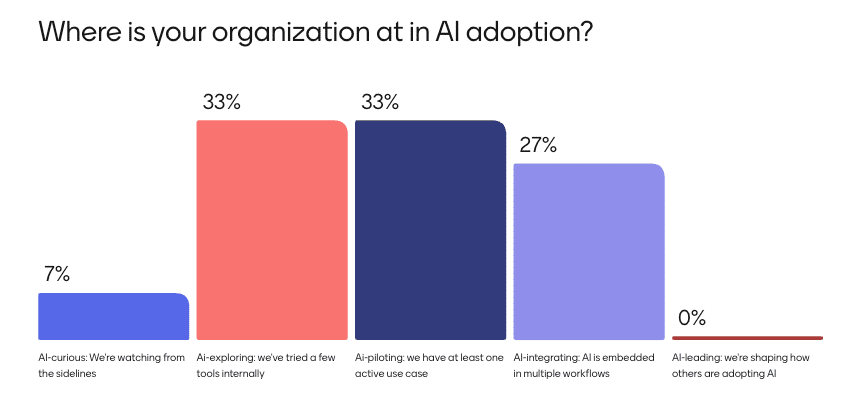
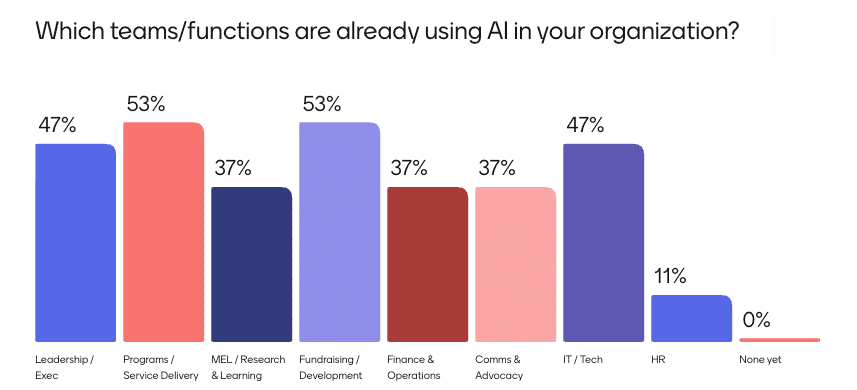
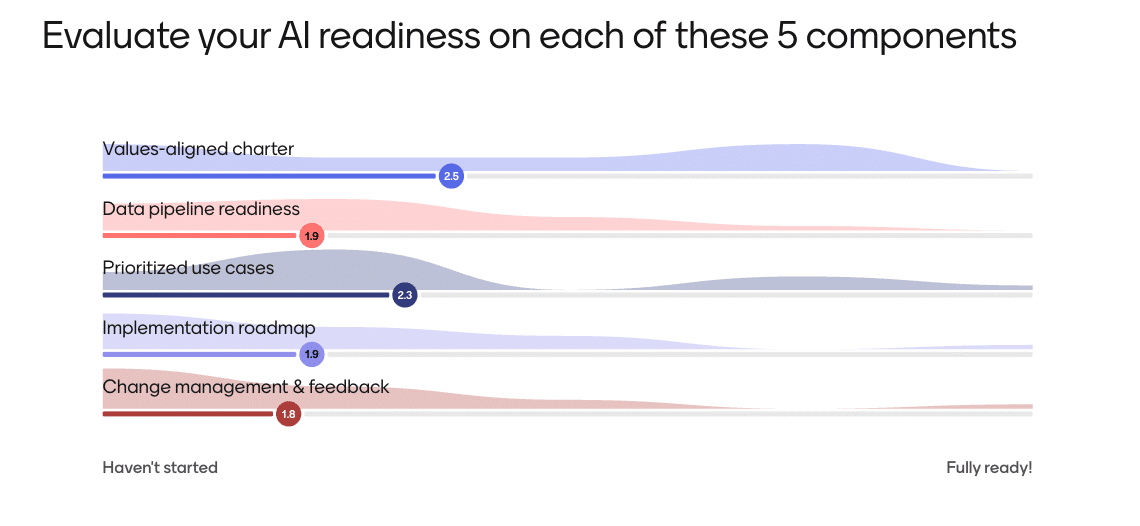
We also challenged a common misconception: AI readiness isn’t only for large nonprofits with perfect data and big tech budgets. It requires intention and structure, not scale, which means organizations of all sizes can start. With that grounding, we introduced the five pillars of AI readiness that Vera uses to help organizations assess where they stand and where to focus next.
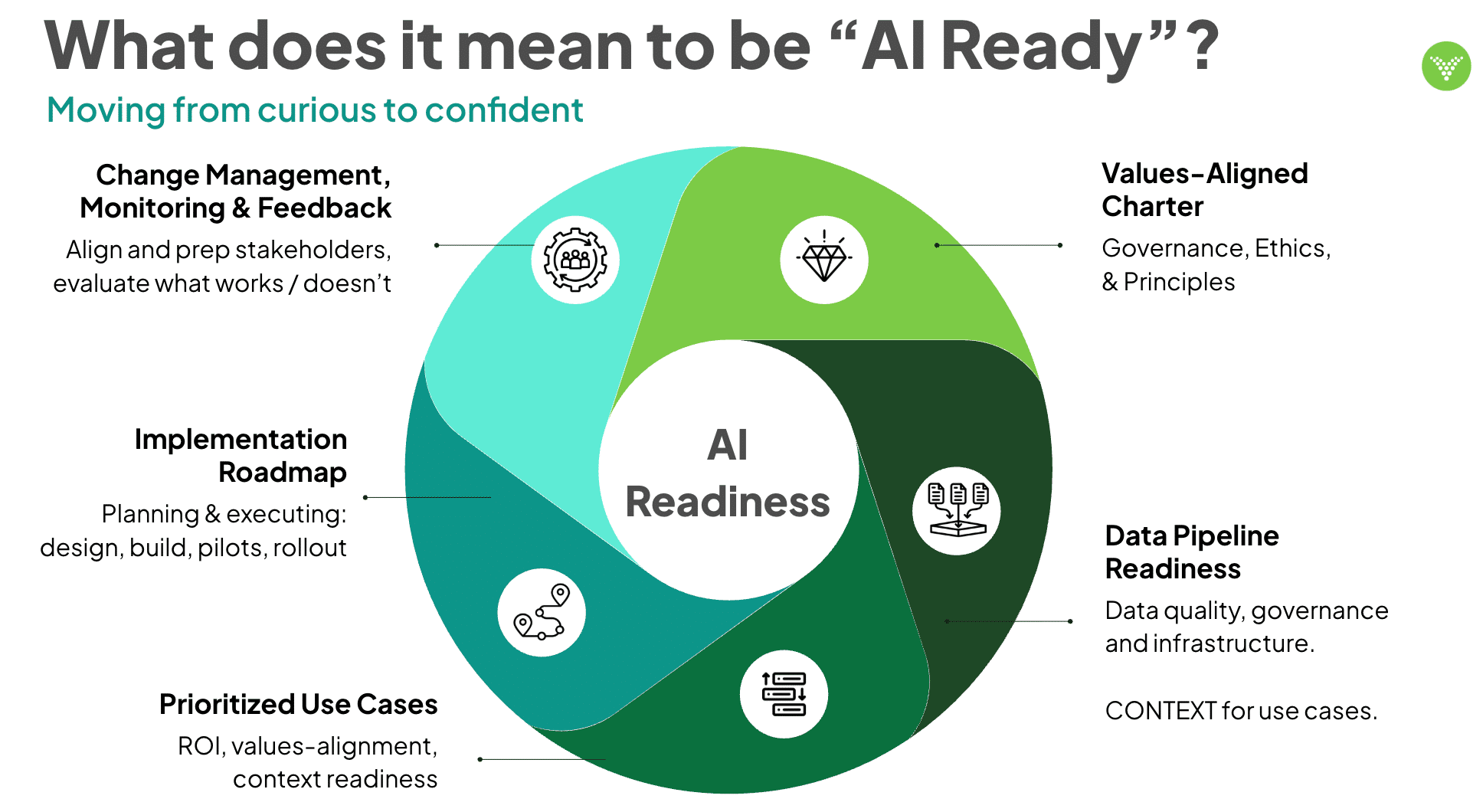
Pillar 1: Values-Aligned Charter
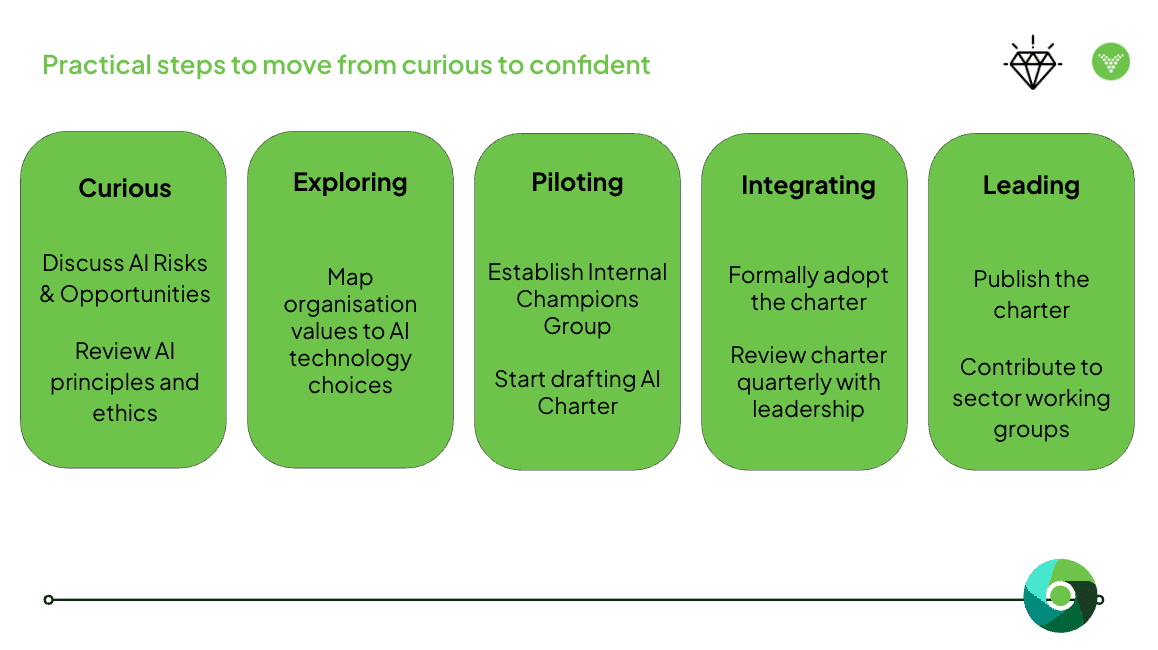
This pillar emphasizes governance: having a clear, written stance on how your organization will use AI. Start with internal conversations: What are the risks? What are our principles? You don’t need a polished document on day one. Begin by mapping your organizational values against your technology choices, then gradually formalize from there. The milestone to aim for is a first draft of an AI charter, reviewed regularly with leadership. At the leading stage, you publish it externally and contribute to sector-wide conversations on responsible AI.
Two free resources to get you started: Vera’s Nine Principles of Responsible AI for Nonprofits and NTEN’s AI policy template. Both can serve as a practical starting point for drafting your own charter.
Pillar 2: Data Pipeline Readiness
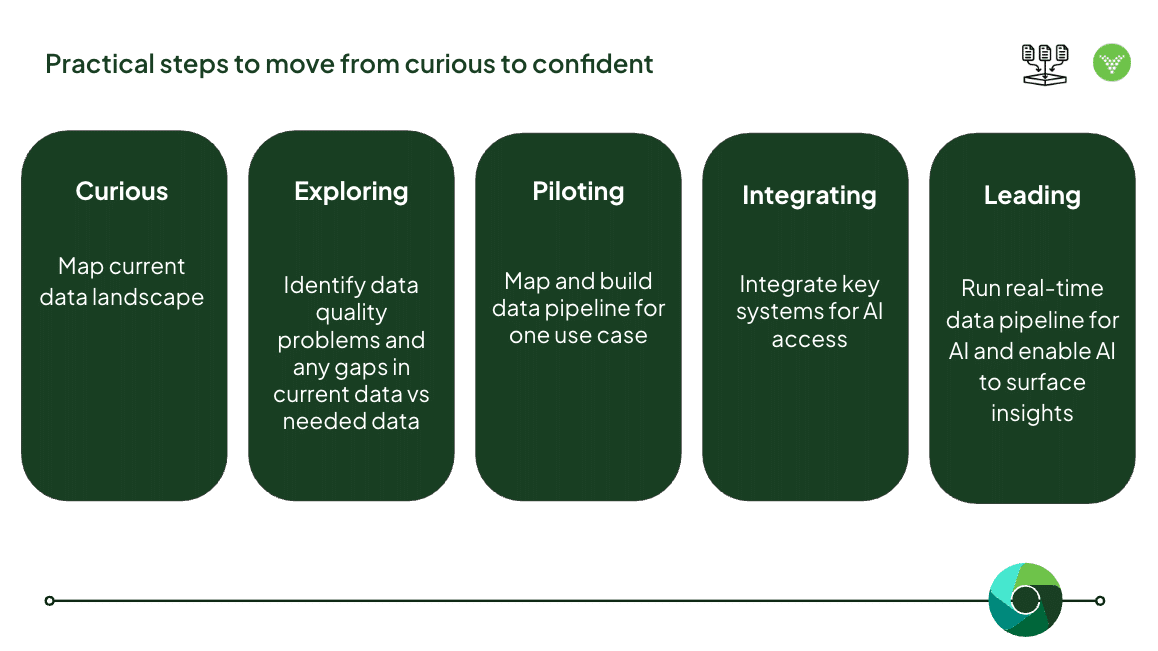
AI is only as useful as the context you feed it. If your data is scattered, inconsistently formatted, or siloed across systems without a common data model, even the most capable model will struggle to deliver meaningful results.
At the curious stage, you’re mapping what data you have, who owns it, and whether it’s clean. As you mature, you identify quality gaps for specific use cases, build pipelines, ensure the right systems are integrated, and eventually reach a place where AI can surface insights across your data. Most organizations we speak to are somewhere in the middle: data needs intentional mapping and clean-up before it’s ready to power AI automation.
A practical starting point is a self-assessment across four questions:
- Do you know what data you have?
- Is it clean?
- Can the right people access it?
- Do you have governance around it?
Reach out to schedule a free data readiness workshop with Vera and work through these questions together.
Pillar 3: Prioritized Use Cases
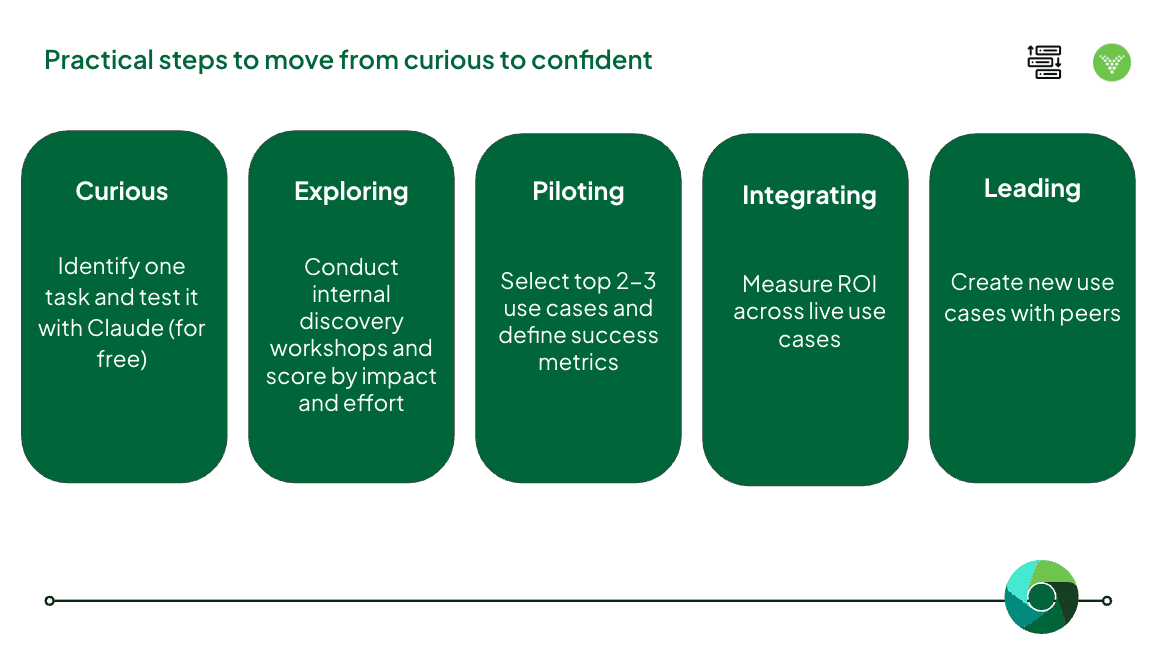
This pillar is about identifying what’s costing your team time or quality, and asking whether AI is the right tool for it. At the curious stage, the most useful thing to do is pick one task and try it. Claude is free to explore. The goal is to build intuition for what these tools can and can’t do. As you progress, you run discovery workshops with different departments, score use cases by impact and effort, and narrow down to a shortlist with defined success metrics. At the integrating stage, you’re measuring ROI across what’s live. At the leading stage, you’re co-creating use cases with peers across the sector. Our Vera AI Peer Learning Groups are a helpful place to collaborate and learn alongside other social impact organizations. You can register to join here.
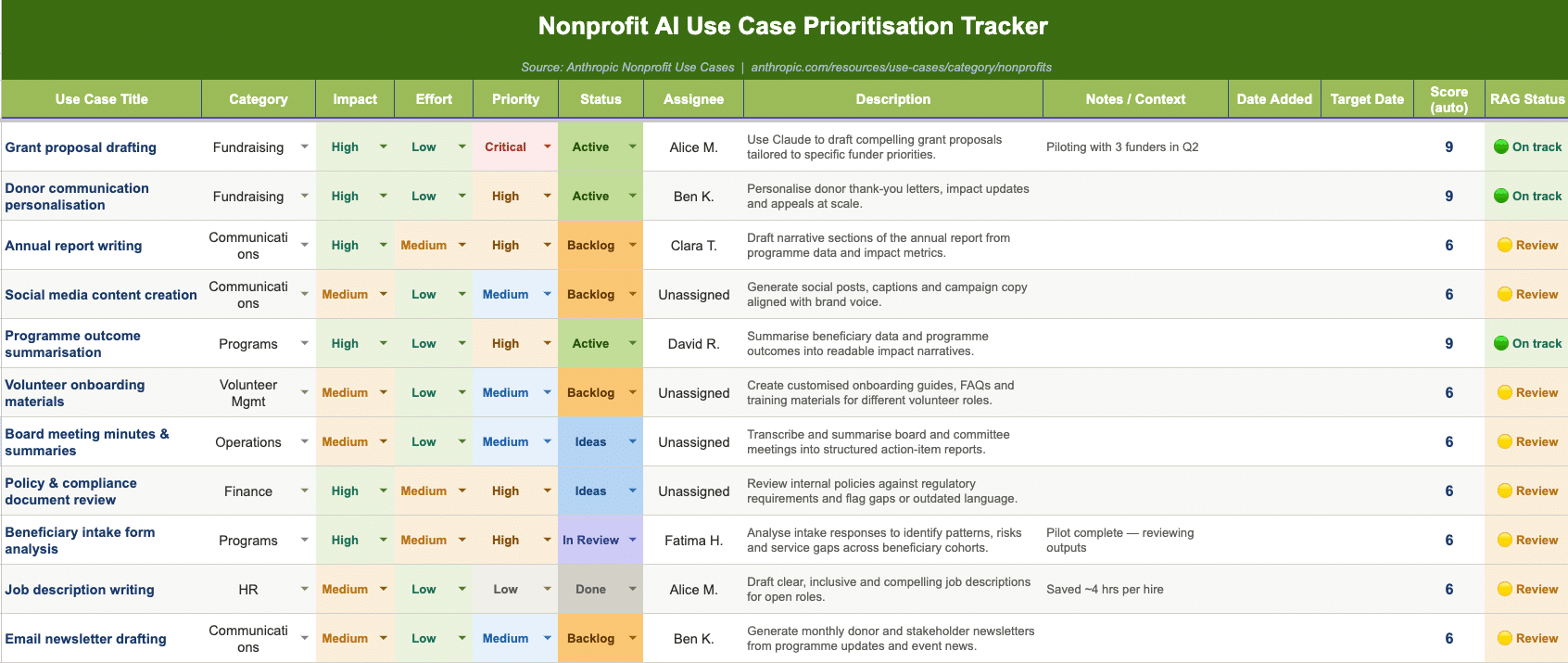
Two helpful starting points for prioritizing use cases: Anthropic’s nonprofit use case library and a pre-filled use case backlog and prioritization tracker.
Pillar 4: Implementation Roadmap
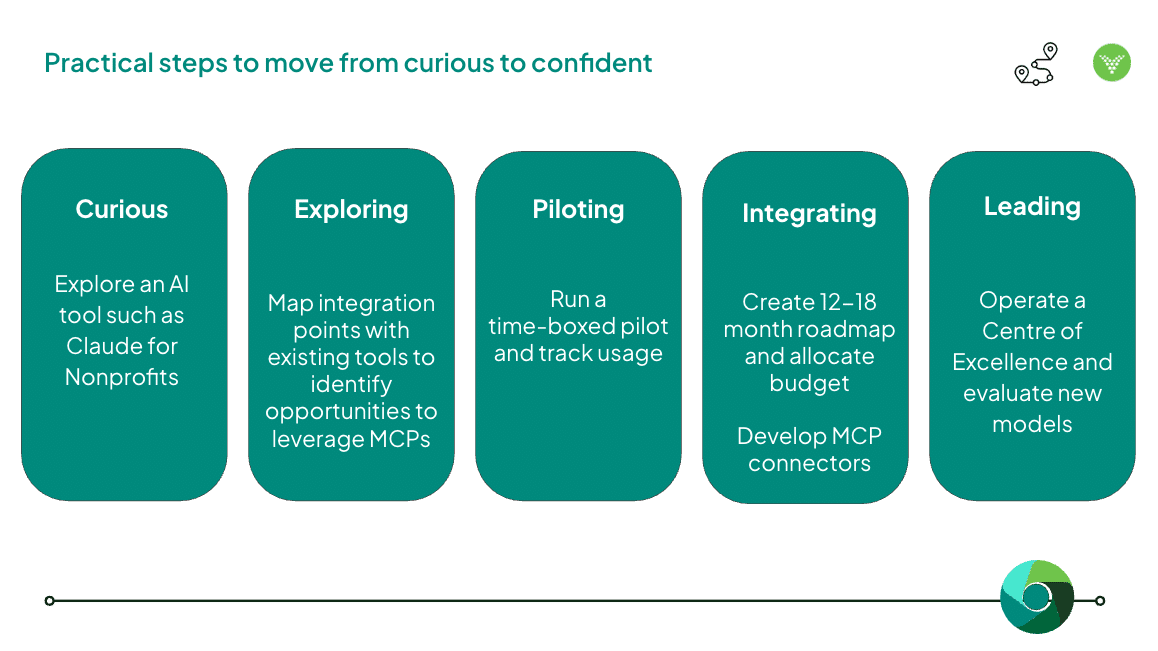
Once you’ve identified use cases, this pillar is about building and deploying them within your broader IT strategy. Early stages involve exploring tools such as Claude for Nonprofits and mapping how they connect with what you already use, including through MCP (Model Context Protocol) connectors that link AI tools to your existing systems (you can learn more about some of these MCPs here). Piloting entails running a time-boxed experiment with real users and tracking what changes, not just whether people used the tool. Over time, this evolves into a 12-18-month roadmap with an allocated budget, custom MCP connectors, and a Center of Excellence that owns the AI strategy and capability-building across the organization.
Pillar 5: Change Management, Monitoring, & Feedback
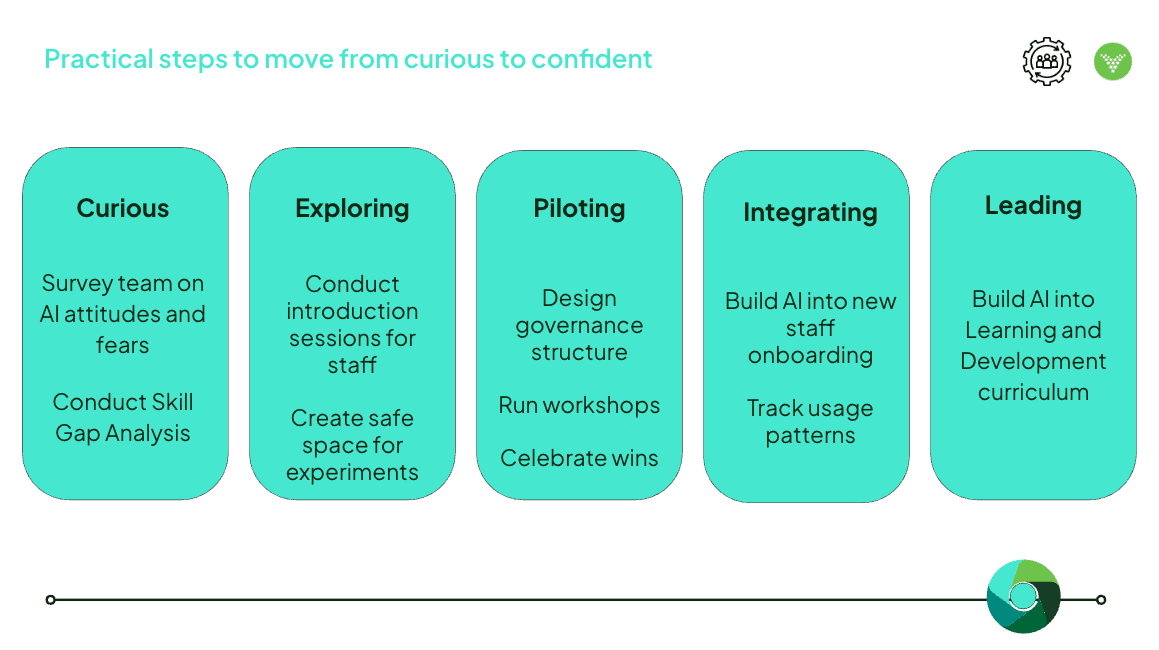
Technology fails when people don’t trust it, weren’t involved in decisions about it, or lack the skills to use it effectively. That’s why change management is the fifth, and most underestimated, pillar. A good place to start is a team survey of attitudes and concerns to understand what you’re working with. From there, create spaces where people feel safe to experiment. As you progress, you’re training staff, celebrating wins, designing governance structures, and embedding AI literacy into staff onboarding and learning-and-development curricula.
A simple first step: identify two or three people in your organization who are already curious about AI, nominate them as informal champions, and give them space and permission to explore.
Putting It Into Practice: A Real Client Example
We’re currently working with a global health nonprofit to support their movement from AI-curious to AI-leading. When we engaged them, they were operating in a state familiar to many: individuals using ChatGPT independently, some experimentation with AI process automation, no shared organizational AI context, and leadership that recognized the opportunity but hadn’t yet structured a path forward.
Through a focused AI advisory and Claude for Nonprofit build engagement, we’re moving them toward centralized use of Claude as their primary LLM — integrated with existing systems, with two initial AI-powered workflows in development, a usage policy and security framework in place, and a growing organizational AI literacy. We’re applying all five pillars: starting with a first-version charter and an internal champions group, running data discovery workshops to understand source quality and gaps, collaborating on use case identification with our ROI calculator, setting up Claude for Nonprofits licenses with standard MCP connectors, and running enablement sessions to build staff fluency.
This client will be featured in our next webinar – a chance to hear directly from an organization actively navigating this journey. Stay tuned!
Moving Forward
AI readiness isn’t about having everything figured out before you begin; it’s about building momentum across the five pillars in a way that’s grounded in your organization’s values, data, and capacity. The organizations that will lead on AI aren’t necessarily the largest or best-resourced; they’re the ones that start intentionally and keep moving.
Reach out for a free AI consultation or data pipeline workshop if we can be of support in helping you advance from AI-curious to AI-leading.
FAQs
We're a small nonprofit with limited technical capacity. Is the AI Readiness framework realistic for us?
Yes. The five pillars don’t require large budgets, technical teams, or perfect infrastructure. They require intention and structure. Many of the early-stage actions, such as mapping your data landscape, conducting a team survey, or testing a single use case in Claude, can be done with existing staff and free tools. The framework is designed to meet you where you are, not where you wish you were.
Our data is messy. Should we wait until it's clean before pursuing AI?
Not necessarily, but data readiness is important, and it’s one of the reasons we’ve made it a dedicated pillar. AI is only as useful as the context you give it. That said, “waiting until data is perfect” is often a way of never starting. We recommend beginning with a data inventory: know what you have, who owns it, and how clean it is. From there, you can scope use cases that fit your current data reality while working in parallel to improve quality for higher-stakes applications.
What is an AI charter, and how do we start drafting one?
An AI charter is a written document that articulates how your organization will use AI, including the principles, values, and guardrails that guide those decisions. It doesn’t need to be long or polished to be useful. Good starting points include Vera’s Nine Principles of Responsible AI for Nonprofits and NTEN’s AI policy template. Starting the conversation about risks, ethics, and values internally is a meaningful first step, even before any document is finalized.
What's the difference between a "use case backlog" and an "implementation roadmap"?
A use case backlog is a list of AI applications your organization could potentially pursue, scored and prioritized by impact and effort. An implementation roadmap is the plan for building and deploying the highest-priority items from that backlog, with timelines, budget, resources, and milestones. You need the backlog to inform the roadmap. Both are living documents that should be revisited regularly as you learn from pilots and as AI capabilities evolve.
How do we measure whether our AI investments are working?
This is where the ROI and change management pillars intersect. Before building a use case, define what success looks like, whether that’s time saved, quality improved, or cost reduced. During pilots, track usage patterns and gather user feedback. Over time, this feeds into a continuous improvement roadmap. We use an ROI calculator with clients to quantify the value of specific workflows before and after AI implementation, making the case for further investment much more concrete.